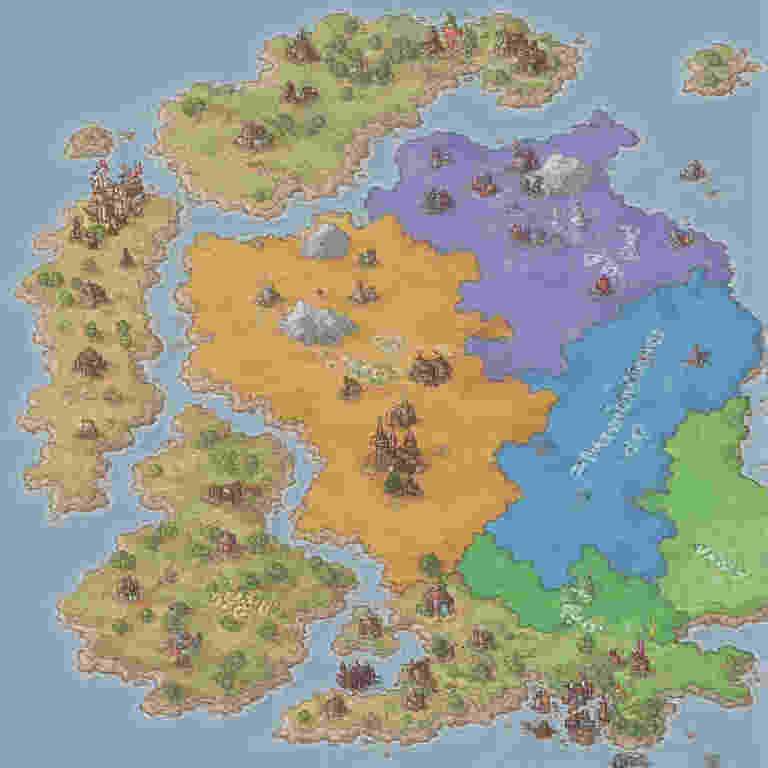

Strategy games—those cerebral powerhouses where every decision shapes empires, battles, and destinies—stand as one of video gaming’s most intellectually rewarding and commercially dominant genres. At their core, strategy games challenge players to plan, allocate resources, manage units or economies, and outmaneuver opponents to achieve victory conditions like conquest, survival, or dominance. Unlike twitch-based shooters or narrative-driven adventures, they prioritize foresight, adaptation, and long-term thinking, often blending competition with creativity. From commanding legions in Total War: Warhammer III to colonizing galaxies in Stellaris, strategy games reward brains over reflexes, fostering “just one more turn” addiction that’s hooked billions.
Born from ancient board games like Chess (6th century origins) and Go (circa 2500 BCE), the genre digitized in the 1970s and exploded commercially, generating massive revenue—Civilization alone sold 50+ million copies across entries. In 2025, with hits like Manor Lords, Sid Meier’s Civilization VII, and Frostpunk 2 dominating Steam charts and Age of Empires IV esports, strategy remains a top genre, appealing to 20%+ of PC gamers. This article unpacks what defines strategy games, traces their fascinating history, explores some key subgenres with vivid examples, and reveals why they’re irresistibly popular today.
What Makes a Game “Strategy”? The Core Pillars
Strategy games hinge on high-level decision-making over micro-actions, typically featuring:
- Resource Management: Gather food, gold, or mana to fuel growth (Age of Empires villagers chop wood).
- Unit/Command Control: Direct armies, heroes, or fleets (StarCraft II Zerglings swarm).
- Victory Paths: Dominate via military (Warcraft III), culture/diplomacy (Civilization VI), or economy (Stellaris).
- Fog of War/Scouting: Hidden maps revealed by explorers (Total War: Pharaoh spies).
- Scaling Scope: Micro battles to macro empires.
They split into turn-based (deliberate pacing, XCOM 2) and real-time (constant pressure, Company of Heroes 3), with hybrids like Homeworld 3 blending both. Accessibility varies: casual (Plants vs. Zombies) to hardcore (Crusader Kings 3 dynasties).
A Timeline of Strategy Gaming: From Ancient Boards to Digital Empires
Strategy’s roots predate computers, evolving through milestones that shaped modern play.
Ancient Foundations: Board Game Ancestors (Pre-1970s)
Chess (India, 6th century CE; modern rules 15th century Europe) pioneered piece asymmetry and checkmate—digital heirs like Chess Titans echo its tactics. Go (China, ~2500 BCE) emphasized territory control, inspiring Digital Go apps. Risk (1957) global conquest influenced Axis & Allies.
Early computers: 1956’s MANIAC chess program; 1960s PLATO network Empire (multiplayer conquest).
1970s-1980s: Digital Dawn on Consoles & PCs
Invasion (1972, Magnavox Odyssey)—first console strategy—mimicked Risk with Pong battles. Utopia (1981, Intellivision)—pioneering RTS—managed islands in real-time. Wargames boomed: Eastern Front (1941) (1981, Atari 800) hex-grid Eastern Front; Computer Bismarck (1980) naval sim. Sid Meier’s Pirates! (1987) swashbuckling trade/raids set seafaring standards.
1990s: Genre Explosion – RTS & 4X Defined
Civilization (1991, Sid Meier)—4X blueprint—explore/expand/exploit/exterminate across eras. Dune II (1992, Westwood)—RTS godfather—base-build, harvest spice, crush foes. Warcraft: Orcs & Humans (1994), Command & Conquer (1995) popularized factions. Heroes of Might & Magic II (1996) TBS adventuring. Age of Empires (1997) historical campaigns.
2000s: Multiplayer & Hybrids
StarCraft (1998/2000 Brood War)—esports pioneer—Terran/Terran/Zerg balance. Total War: Shogun (2000) RTwP (real-time with pause). Company of Heroes (2006) squad tactics. Civilization IV (2005) mods/esports.
2010s-2020s: Grand Scale & Esports
Crusader Kings II (2012) dynasty sims. XCOM: Enemy Unknown (2012) permadeath squads. MOBAs: League of Legends (2009), Dota 2 (2013). Stellaris (2016) space 4X. 2025 hits: Manor Lords (medieval sim), Civ VII (era-spanning), Frostpunk 2 (survival city-builder).
Strategy Subgenres: A Diverse Arsenal of Playstyles
Strategy’s strength? Subgenres catering to tastes—from frantic RTS to contemplative 4X. These are example of subgenre (not all).
| Subgenre | Description & Details | Iconic Examples |
|---|---|---|
| 4X (eXplore, eXpand, eXploit, eXterminate) | Empire-builders: Scout maps, colonize, tech/economy boom, conquer. Turn-based pacing allows deep planning; victory via domination/culture/science. | Civilization VI/VII (nukes/diplomacy), Stellaris (galactic crises), Endless Legend (factions), Master of Orion (space races), Humankind (cultures). |
| Real-Time Strategy (RTS) | Simultaneous action: Build bases, mass armies, micro battles in real-time. High APM (actions per minute) rewards multitasking. | StarCraft II (macro/micro), Age of Empires IV (civ campaigns), Warcraft III: Reforged (heroes), Command & Conquer Remastered (harvesting system). |
| Turn-Based Strategy (TBS) | Pausable turns for deliberate tactics: Position units, manage queues. Emphasizes foresight over speed. | Civilization series, Heroes of Might & Magic III (towns/heroes), XCOM 2 (squad permadeath), Battle for Wesnoth (open-source). |
| Grand Strategy | Macro nation-sim: Diplomacy, economy, wars over centuries. Complex systems, mods extend play. | Crusader Kings 3 (dynasties), Europa Universalis IV (colonialism), Hearts of Iron IV (WW2), Victoria 3 (industrialization). |
| MOBA (Multiplayer Online Battle Arena) | 5v5 lane-pushing: Heroes level/items, objectives like towers/ancient. Esports focus. | League of Legends (champs), Dota 2 (creeps), Smite (third-person). |
| Tower Defense | Place towers to fend waves: Upgrades, paths, heroes. Casual/mobile-friendly. | Plants vs. Zombies (zombies/plants), Kingdom Rush (towers/heroes), Bloons TD 6 (monkeys). |
| Auto-Battler | Build teams for AI fights: Synergies, positioning. Live-service. | Teamfight Tactics, Dota Underlords. |
| Artillery | Physics-based indirect fire: Angle/power shots over hills. | Worms Armageddon (custom teams), Pocket Tanks. |
Why Strategy Games Are So Popular: The Intellectual Thrill
- Mental Challenge & Mastery: Outsmart foes—Civ’s “one more turn,” StarCraft APM highs. Brain-training appeal, like chess apps.
- Replayability: Procedural maps, AI variability, mods (Total War overhauls). Infinite strategies.
- Social/Competitive: Esports (LoL Worlds 100M+ viewers), co-op (They Are Billions defenses).
- Power Fantasy: From peasant to emperor (CK3), god-king (Stellaris).
- Accessibility Spectrum: Casual TD to deep GS (EU4 1000+ hours).
- Narrative Emergent: Player-driven stories via choices.
2025’s Civ VII, Manor Lords prove vitality—Steam’s top-sellers.
Strategy’s allure? Empowers minds, forges bonds, never ends. Command your next empire!



Pingback: How Playing Video Games Can Improve Your Life – Akusaa.com discuss Anime, Gaming, and misc things
Pingback: What about Popular Video Games in India, Russia, and Africa? – Akusaa.com discuss Anime, Gaming, and misc things
Pingback: Alien Invasion Games : The Thrill of Invaders from Beyond – Akusaa.com discuss Anime, Gaming, and misc things