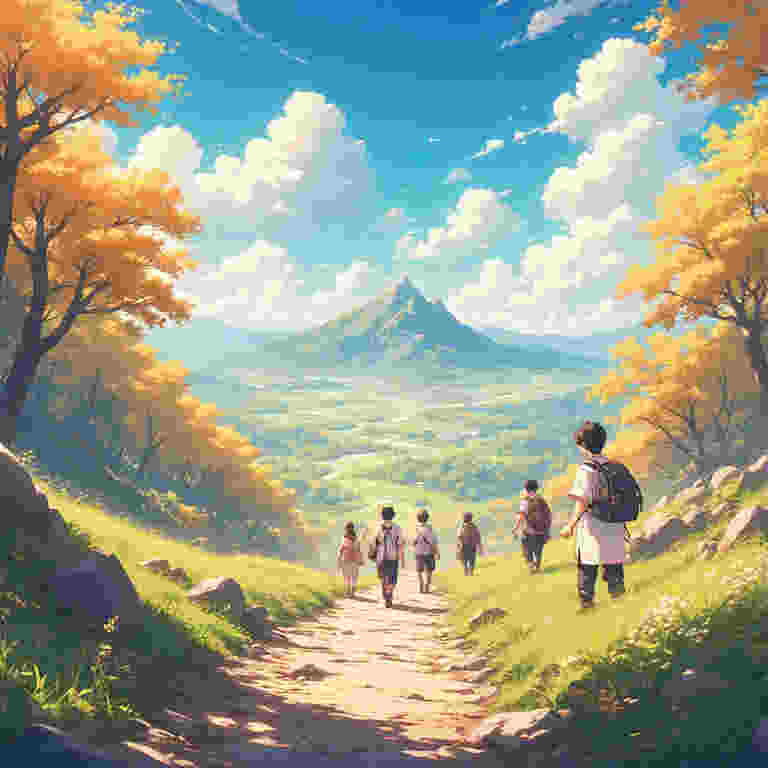

At the heart of countless beloved stories lies a simple, primal urge: the desire to see what lies beyond the familiar hill, to cross the next river, to chase a distant light. This is the essence of the Adventure genre in anime and manga. It is more than a plot structure; it is a narrative philosophy of movement and discovery. Its stories are defined not by a specific setting, but by a relentless forward momentum, where the journey itself—the people met, the obstacles overcome, the wonders witnessed—is the ultimate destination. The genre’s popularity is a testament to our timeless fascination with the unknown and the transformative power of leaving home.
Defining the Adventurer’s Spirit: The Pillars of the Journey
The adventure genre is built upon foundational principles that separate it from mere action or fantasy. Its core identity is forged through:
- The Primacy of the Journey Over the Destination: While a goal often exists (find a treasure, reach a place, fulfill a promise), the narrative weight is placed on the process of travel. The detours, the unexpected encounters, and the gradual accumulation of experience are the story’s true heart. The destination is often a catalyst, not the sole point.
- Exploration and Discovery as Core Motivations: Curiosity is the adventurer’s primary fuel. The drive to map the unknown, understand a mystery, or simply witness the breadth of the world propels the narrative. This creates a sense of wonder and constant novelty, as each new location, culture, or natural phenomenon is revealed.
- A Dynamic, Evolving World: The adventure genre demands a world worth exploring. This means a setting rich in geographical diversity, distinct cultures, hidden histories, and unexplored frontiers. The world is a character, an antagonist, and a reward all at once.
- The Growth of the Traveler: The physical journey is mirrored by an internal, character-driven journey. The protagonist is changed by the road. They gain wisdom, confront their flaws, forge unbreakable bonds, and redefine their understanding of themselves and the world. The adventure is a crucible for personal transformation.
- The Encounter with the “Other”: Travel inherently involves meeting those who are different. Adventures thrive on cultural exchange, forming alliances with unlikely companions, and navigating foreign customs. This expands the protagonist‘s (and the audience’s) perspective beyond a single, parochial view.
Charting the Course: The Evolution of Adventure
The genre’s roots are ancient, but its modern expression in Japanese media followed a clear, evolving path.
The Foundational Voyages (1960s-70s): The Classic Quest
Early anime adventure drew from global folklore and the nascent medium’s sense of possibility.
- Astro Boy: While sci-fi, its episodic structure often sent its hero on missions that explored a futuristic world and its moral dilemmas.
- The Wonderful World of Puss ‘n Boots and other Toei Doga films established a template of fairy-tale questing.
- The true blueprint arrived with Hayao Miyazaki and Isao Takahata’s Lupin III (1971), which, while a heist series, was fundamentally a globetrotting adventure of style and spontaneity. Miyazaki’s own Future Boy Conan (1978) was a seminal post-apocalyptic survival adventure.
The Golden Age of Exploration (1980s): Refining the Epic
This decade saw adventure become synonymous with epic world-building and character-driven sagas.
- The Landmark: Nausicaä of the Valley of the Wind (1984 manga/film) presented a breathtaking, toxic-yet-beautiful world to explore and save, blending ecological adventure with a pacifist heroine’s journey.
- The Shonen Adventure Standard: Dragon Ball (1986) began not as a battle manga, but as a comedic, fantastical adventure inspired by Journey to the West. Goku‘s early quest for the Dragon Balls was a pure travelogue of strange lands and stranger people.
- The Cinematic Masterpiece: Castle in the Sky (1986) is arguably the purest Ghibli adventure—a chase through floating ruins, ancient robots, and sky pirates, driven by the thrill of discovery and the awe of a lost civilization.
- Dark Adventure Unleased: Berserk (1989) is an epic adventure that whips up a frenzy of dark fantasy and action, perfect for anyone craving a deep, intense ride.
The Renaissance and Diversification (1990s-2000s): Scale and Heart
Adventure narratives expanded in emotional depth and scale, often blending seamlessly with other genres.
- The Catch Them All Legend: Pokémon (1996) Pokémon is an adventure classic that never gets old! With Ash Katchum’s journey to become a Pokémon Master, you’ll be swept up in a world of excitement, friendship, and growth. Each new region brings new challenges, legendary creatures, and adorable Pokémon to catch. The thrill of battle, the joy of discovery, and the bond between trainers and their Pokémon make for an epic adventure that’s fun for all ages.
- Saiyan Space Journey: Dragon Ball GT (1996) is a wild and wacky adventure that takes Goku and his friends on a cosmic journey through space. With its blend of action, comedy, and heart, DBGT is a thrilling ride that never lets up. The series’ focus on teamwork, perseverance, and friendship makes it a classic adventure that’s fun for fans of all ages.
- The Epic That Redefined Scale: One Piece (1997) is the undisputed king of modern adventure. Eiichiro Oda constructed a world so vast (the Grand Line), so culturally diverse (countless islands with unique ecosystems and societies), and so deeply layered with history that the simple act of sailing from one island to the next promises the unknown. The Straw Hats‘ journey is the genre’s apex.
- The Introspective Journey: Mushishi (1999) presents a quieter, episodic form of adventure. Ginko’s travels are not toward a single goal, but a perpetual wandering to understand the mysterious Mushi, exploring the relationship between nature, spirit, and human life in tranquil, philosophical vignettes.
- The Emotional Expedition: Hunter x Hunter (1998) frames its adventure around a highly defined world with strict rules (Hunter Licenses, Nen). Gon’s quest to find his father is a vehicle to explore this complex world, where each story arc is a self-contained adventure in a new, dangerous environment (the Trick Tower, the auction city, a video game world).
- Digital Adventure: Digimon (1999) is an adventure that combines the best of action, adventure, and fantasy. The DigiDestined’s journey to save the Digital World is filled with exciting battles, heartwarming moments, and unforgettable characters. With its unique blend of technology and magic, Digimon is a thrilling adventure that’s sure to captivate audiences of all ages.
- Samurai and Alien: Gintama (2003) is an adventure that’s as unpredictable as it is hilarious. With Gintoki and his friends’ crazy antics, you’ll be laughing and crying in equal measure. The series’ unique blend of sci-fi, comedy, and action makes it a wild and wacky adventure that’s impossible to put down. Whether you’re a fan of sword fights, space battles, or just plain silly humor, Gintama’s got you covered.
- The Inner and Outer Quest: Fullmetal Alchemist: Brotherhood (2009) is an adventure that masterfully blends fantasy, action, and drama. Edward and Alphonse Elric’s quest to restore their bodies takes them on a perilous journey filled with complex characters, moral dilemmas, and intense battles. With its rich world-building and compelling narrative, FMA: Brotherhood is an unforgettable adventure that’ll keep you invested in the characters’ fates.
The Modern Landscape (2010s-Present): Specialization and New Frontiers
Today, adventure often intersects with dominant trends like Isekai, but retains its core spirit.
- The “Adventure” Isekai: Made in Abyss (2012) is a devastatingly beautiful and brutal vertical adventure. The descent into the Abyss is a literal and metaphorical journey into the unknown, with each layer presenting new ecological wonders and existential horrors. It captures the classic冒险 spirit of discovery paired with grave consequence.
- Exploring in Bizarreness: JoJo’s Bizarre Adventure (1987 as a Manga, 2012 as an Anime) is an adventure that defies explanation, and that’s what makes it so amazing. With its unique blend of action, horror, and humor, JJBA is a wild ride that’ll keep you on the edge of your seat. The series’ focus on character development, Stand abilities, and epic battles makes it a thrilling adventure that’s sure to captivate fans of fantasy and action.
- The Comfort Adventure: Laid-Back Camp (2015) democratizes adventure. It presents the Japanese countryside as a world of gentle discovery, where the adventure is in finding a perfect campsite, cooking a meal outdoors, and enjoying solitude or friendship in nature. It proves adventure can be a state of mindful presence.
- The Supernatural Trek: Demon Slayer (2016) and Jujutsu Kaisen (2018), while battle shonen, are structured as journeys. Tanjiro travels across Taisho-era Japan hunting demons; Yuji and his colleagues are dispatched to cursed locations nationwide. The adventure lies in the changing settings and the incremental uncovering of each world’s lore.
- The Anthropological Adventure: Golden Kamuy (2014) is a historical survival adventure across the wilderness of Hokkaido. The adventure is as much about navigating the harsh landscape and its wildlife as it is about engaging with the rich, respectfully depicted culture of the Ainu people.
The Engine of Wanderlust: Why Adventure Endures
The genre’s unwavering popularity speaks to fundamental human desires:
- The Escape into Wonder: It offers pure, untethered escapism into realms of imagination, satisfying an innate curiosity about what lies beyond the map’s edge.
- The Fantasy of Possibility: It promises that the world is larger, more mysterious, and more magical than everyday life suggests. There are always new friends to meet, secrets to uncover, and horizons to chase.
- The Metaphor for Life: The journey is a universal metaphor for personal growth, maturation, and finding one’s place in the world. Audiences see their own struggles and triumphs reflected in the traveler’s path.
- The Celebration of Resilience: Adventure narratives champion adaptability, courage, and the ingenuity needed to overcome unforeseen obstacles—a deeply inspiring and empowering message.
- The Ultimate Vehicle for World-Building: For creators, it is the perfect framework to showcase their imagination. The traveling protagonist acts as the audience’s guide into a meticulously crafted universe.
Conclusion: The Road That Never Ends
The adventure genre in anime and manga proves that storytelling, at its best, is an act of invitation. It invites us to set sail with Luffy, to fly with Sheeta and Pazu, to wander with Ginko, or to camp with Rin. It asserts that the most important stories aren’t about where you are, but about where you’re going, who you become along the way, and what you learn to cherish.
Its popularity is eternal because the call to adventure is written into the human spirit. In an increasingly connected yet paradoxically isolating world, these stories rekindle the primal thrill of the unknown and the profound truth that we are all, in some way, travelers. The genre’s legacy is a simple, powerful promise: that as long as there are stories, there will be a road, a ship, or a star to follow, and the journey will always be worth taking.




Asking questions are truly good thing if you are not
understanding anything completely, but this article
gives fastidious understanding yet.
I like this genre
Awesome blog article.Much thanks again. Much obliged.
Awesome article.Really thank you! Awesome.
Great